Common Exercise Injuries To Look Out For
One of my passions lies in sports medicine, specifically Athletic Training (hence the ATC/L credentials).
How to maximize your shoulders’ ability to move in a safe and injury resistance manner.
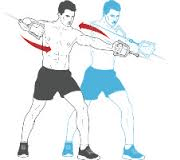
How are you going to translate the force produced from those strong legs to the arms? By utilizing the Serape effect of course!!!!
Imagine your body is made up of two big blocks of meat. You have your upper body and you have your lower body. Now imagine you want to use both of those big blocks of meat simultaneously to do something like throw/hit a ball, dig a hole or golf , push a cart full of groceries, or punch a heavy bag. How are you going to translate the force produced from those strong legs to the arms? By utilizing the Serape effect of course!!!! The Serape effect is basically the use of the core to translate force from the lower body through the arms. There are a variety of “functional” exercises that you can, and should, be doing to make sure you’re not overusing joints which can lead to injury. So now that you have a little background knowledge, let’s dive into today’s post!
“Functional”
The term “functional training” is a bit of a buzzword garbage term. My favorite quote regarding this is from James Fell that says “It’s meaningless. Any time someone says an exercise is functional it means they don’t know what they’re talking about. All exercises are functional. Your mom is functional.” Funny and true. All exercise has function, and a variety of exercise is important to maintain function. For instance, if you exclusively use exercise machines, you may lose the ability to use those strong muscles in a rotational fashion. That’s where the functional aspect of training the Serape comes in. Broadly, the core can be described as being between the joints of the shoulders and hips.The muscles that attach the pelvis, spine, and rib cage perform many functions. Hip musculature generates the majority of power, then transfers it upward through the linkage to the arms through a “stiffened” core, which creates efficient transfer of forces, and is one of the keys to injury prevention. The Serape involves these features from both ends of the core in a spiral pattern (1). It actually wraps itself around the trunk of the body, perfectly designed for rotating the hips and shoulders in an opposite direction allowing the hips to lead and the shoulder to follow in many ground-based activities such as throwing, batting, golfing, or punching (2). Take a look at the pictures below and/or this video for a good visualization of how it works.
If you’re a nerd like me and want to know what exact muscles are involved, here are some pictures detailing the exact muscles used with the Serape.
Serape Training For Beginners
Training the Serape muscles is easier than it looks. Yes, there are a lot of muscles involved. But remember, we are not isolating any single muscle in particular, we are learning how to use them all in an efficient manner. If you’re not doing so already, you will want to start doing Olympic-style lifts and traditional strength lifts such as squats, bench press, and pull-ups. These are non Serape specific exercises, but if you don’t have strength in the upper and lower body then you won’t have strength to translate through the core to begin with! You will also want to start by training the four basic trunk movement patterns with dynamic and/or static exercises. Beginners should do exercises that train in what we call single-plane basic movement patterns. Single-plane exercises are usually easy to learn and include exercises such as the crunch (trunk flexion), back extension/hyper-extension (trunk extension), Russian twist (trunk rotation), and side bend (lateral flexion) (3).
For those more advanced, you may want to consider multi-plane exercises that target areas you’re not getting with your standard training. This is because there is huge inter-personal variety in terms of which ab-exercises work best for whom (4). By simply extending your arms over your head during a crunch, you can drastically increase abdominal muscle involvement. Take a look at the chart below to get an idea of what exercises work for different parts of the core (the lower the number the better). Before we move on to the last section of this post, I think it’s important to note that any exercise performed for abs will always use all the muscle groups that compose the abdominal wall when done correctly. Proper technique is paramount to all exercise, so make sure that you consult a professional if you are a novice, are unsure of what you’re doing, or experience pain during exercise.
Hard Work Pays Off
While it’s been long proven that abdominal exercises won’t turn a beer belly into a six pack, we do know that core exercises are paramount for a healthy body and for safety during exercises that will get you strong and help you lose weight (5). Core stiffness enhances athletic performance, and guess what your doing at the gym?… performing athletically (6)! So once you have set the foundation of a strong body, you can get into the fun exercises that greatly enhance your athletic performance on and off the playing field, (aka daily life activities). Here are some of the best ways to train the Serape movement pattern:
– Rotating exercises done from a standing position and alternating punching/pressing and pulling
– Utilize various stances, 2-arm and single-arm loading
– Alternating pressing/pulling patterns, as well as different stepping movements
I’ll finish up by reminding you of why we are working on the core and Serape. Muscles of the Serape form a spiraling system that enhances the efficiency of cyclic activity such as walking, together with power and speed activities such as throwing and golf. The stiffened core enables power produced in the lower limbs to transfer to the joints of the upper end of the core (or vice versa) forming a whip. So get of those machines and start whipping yourself into shape!
Don’t forget to like me on Facebook!
References
Foam rolling is a form of self myofascial release (SMR) used on tight muscles. But the question remains… what does foam rolling actually do?!?!
The foot and ankle complex provides a base of support for all of our upright movement, so why don’t more people do exercises to strengthen such an important part of their body?!?!
From young athletes, to chair bound adults, to golden year seniors, almost everyone will experience lower back pain at some point in their life. For this reason I decided to break down LBP into what it is and what to do about it!
2. The hip flexor stretch. A wonderful pairing to the glute bridge is a stretch of the hip flexors. This stretch will allow the butts and guts do their jobs.
4. Leg swings. This will help mobilize the hips so you can use your booty!
This piece of equipment is far too underutilized even though it has oodles of benefits for noodle arms (or nearly any other weak body parts).
Today’s post is all about the row machine! This piece of equipment is far too underutilized even though it has oodles of benefits for noodle arms (or nearly any other weak body parts). It gets you strong, utilizes the whole body, crushes calories, and best of all… you get to sit! So let’s dive into the wonders of rowing.
What Could Be Better?
There’s almost an innumerable amount of benefits to rowing. How could one machine be low impact, strengthening, and cardio all in one? Well, here’s how:
Rowing uses around 86% of the body’s muscles including the upper back, arms, legs, and, yes, even core, which means more calories burned, great heart health, and tremendous bang for your buck.
Depending on how you us it, you can develop power (short pieces), endurance (long pieces), and strength endurance (middle distance pieces).
It has great crossover effect, which means it can be used to develop aptitude in other exercises such as the squat, dead lift, or other weighted rowing motions.
Also, it’s super safe due to minimal impact loading, so it is safe for those with a history of ankle, knee, or hip injuries.
What to Know Before You Go Row
There are three key things to know about the row machine for those beginners out there. They are 1) the Damper setting 2) Flex Foot position, and 3) Performance Monitor adjustment. The damper setting affects wind resistance and subsequently the speed of the stroke: the lower the setting, the less wind resistance and faster the stroke. So basically, the harder you pull, the more resistance will be felt with each stroke – making the workout more challenging. Depending on your goal, you will need to play with different settings, record results and “tweak” as needed. The flex foot is where the feet are fixated, and it needs to be adjusted according to foot size. Just make sure that the anchor strap is secured directly over the ball of the foot for optimal performance. The performance monitor is an essential component to rowing and displays quantitative information for you to analyze the performance of each row. Key features include time, distance, speed as time per 500 meters, watts, and calories per hour. The time per 500 meters is my favorite to watch because it represents to a rower the same as what time per mile represents for a runner.
Technique
As with any other exercise, technique is crucial for attaining benefits and shunning away the bad stuff like injuries (just like Gryffindor’s sword). So here are the step by step instructions for a beginner.
1 – Turn the machine on, set resistance to low, secure your feet so they don’t move around as you slide, and grab the handle using an overhand grip, but don’t hold too tightly
2 – Pull the handle with you as you slide to the end of the machine. Your legs should be straight, but knees should still have a slight bend in them so they aren’t locked. Lean back slightly and pull your hands up to your chest, holding the handle so it is right below your pecs, with elbows pointing down against your sides.
3 – THE RECOVERY is when you start to come forward towards the starting position. To do this properly, move your arms out first, followed by your upper body. Your back should always stay straight, not slumped, with shoulders back and abs engaged as you follow through. As your arms extend out, your upper body position will go from slightly angled back to slightly angled forward.
4 – THE CATCH is when you make your way back to the starting position. As your arms extend and body leans forward, slide your body forward on the seat by bending your legs. Once you are at the top of the machine, your arms will be fully extended and legs will be bent.
5 – THE DRIVE is where the magic happens. This is where you push off with your feet first, so that your legs straighten, but your arms are still extended and your body is still slightly leaning forward working the leg and core muscles the most.
6 – THE FINISH starts when your torso begins to lean back, followed quickly by your arms; as your upper body angles back, pull the handle and bend your arms so that the handle ends up back to touching the front of your chest, just like how you started.
Caution
Here are a few things to look out for. DON’T grip the handle too hard; the power should be through your legs. Using too much force while pulling the cable can cause hand blisters as well as back problems. DON’T slump forward because the core muscles must act to keep the spine in neutral alignment so that power can be transferred from low to high and high to low through the kinetic chain. DON’T move your arms up and down as you row because raising and lowering of the handle during recovery is inefficient, involves more work and should be avoided for optimal rowing. DON’T push the seat away from the flywheel and then follow with the hands and torso. Instead, at the very beginning of the drive phase, make sure the seat and the handle move together for approximately ¼ of a slide, at which point the torso starts to hinge followed by the arm pull. DON’T lean back like you’re taking a nap in your car (or Fat Joe) because it increases the workload on the abdominals, slows pace and decreases overall performance. DON’T chicken wing by raising the elbows vertically at the finish of the stroke like you’re going to choke yourself with the bar.
Workouts!
Here’s the fun part… the workout options! There are a few basic options. I like to row for 10 minutes and see how far I get. You can do the reverse by seeing how long it takes you to get a certain distance (500m for beginners). I like to also use a Fartlek style of training where you go slow for one minute, medium pace for 45 seconds, and all out sprint for 15 seconds for 5-10 rounds. Once you have some experience under your belt, you can try an interval training plan such as this one, or place it strategically into a workout plan like this one. To sum it all up, rowing is a workout that you need to try. Once you master technique, you will be able to take on just about anything (except water)!
The neck is really designed to balance the 10- to 14-pound pumpkin that sits on top of it. The problem arises when your head starts to drift forward.
A few tips to keep your workouts integrative and dynamic while being short and sweet.