What’s Trending?

Like fashion, fitness trends seem to be cyclical. Every 5-10 years an old trend gets re-branded as something new and exciting (e.g. was Adkins now it’s Paleo).

After a brief break, I am back with a new post! This week we are taking a look at some health and fitness trends, and what you need to know about them. Like fashion, fitness trends seem to be cyclical. Every 5-10 years an old trend gets re-branded as something new and exciting (e.g. was Adkins now it’s Paleo). So let’s dive into the “new” trends and take a look at what they have to offer!
The Way You Move
The term “functional training” can mean a lot of things. Are you training to become better at a technical skill like a golf swing? Then sure! That’s functional training. But outside of getting better at a task, the resurgence of functional training has me shaking my head. You’ve probably seen the proponents of various “movement system” training at the gym or Youtube. Crazy folks standing on a wobble board to do squats, trying to mimic the movements of various animals, or doing all manner of contortionist circus tricks while standing on a physio ball attached to various bands, and so on. The people claiming that these exercises are necessary may use sciency-sounding words to justify what they are doing. In reality, there is no real standard to which functional training exists because we all move differently. There is no textbook form/function for specific exercises, but rather guidelines to prevent injuries while exercising. In all, there really is no justification for doing these crazy moves other than wanting to change up your routine. But if you’re trying to get strong and lose weight, well you may want to focus your efforts on practices that have been proven to improve those outcomes.
 
Expert Confusion
Holy crap I’m tired of seeing all these “experts” online. Everyone and anyone with an Instagram account and bulging biceps is apparently qualified to be a coach. This maddening concept is partly responsible for the resurfacing of the “muscle confusion” concept. Good lord it’s time to put that garbage term to bed. Adopting a periodized approach, rather than just winging it and doing something different every time you enter the gym, is a far superior way to see results. These coaches are also to blame for the social media fitness “challenges” that ask for both demanding and dangerous feats of athleticism. Fitness challenges may keep things entertaining, but it may come back to bite you.
 
Lose Weight Fast!!!!
Losing weight is easy. Just sweat a bunch, and you will lose weight. But because most people are looking to improve their body composition, it’s not weight loss that matters. That’s why the “lose weight fast” movement drives me crazy. Here are the tag lines of many “coaches” and/or companies that are essentially scamming us:
You don’t eat enough meals in the day to help your metabolism
You skip breakfast, which means you don’t “turn on” your metabolism to start the day
You don’t do intermittent fasting, which means your hormones are messed up
You eat too late at night and those calories are more likely to become fat
You eat “starchy” carbs, which are transformed into sugar
You eat white foods, such as white rice, which make you fat
You eat gluten or non-organic food sources, which pollute your body
All of these statements are laughably wrong (feel free to ask me for more info if you have questions). But millions of people waste money on products and services each year because these ludicrous statements are branded so well that they become social facts.
One Simple Trick!
It takes years of education and experience for fitness professionals to be able to properly help those they serve. So the insinuation that there is “one simple trick/plan” to help everyone is insulting and maddening. So when you hear/read some of the following statements, think “crap”:
Obesity isn’t a complex disease at all. It’s simple!
Calories don’t count; you just need to balance your hormones.
Hate exercise? There’s a wrap for that, and It Works!
Do fasted cardio to burn fat!
IIFYM bro
When it comes down to it, if you’re not eating well and regularly moving, then there really is no reason for you to even consider these trends. Try to master the basics of eating lots of fruits and vegetables and moving for at least 30 minutes every day. Because like everything else in life, achieving your fitness goals takes patience, dedication, and effort. If it’s truly meaningful to you, shortcuts are not an option.

Thoughts For Food

The “why” behind our food choices.

Today’s post is short and sweet. It comes from an article by the Health Science Academy about factors influencing our food choices. This fantastic review takes an in depth look at the “why” behind our food choices. Although we may think that it’s a simple decision, there are actually a lot of things that we can do to positively influence our decision making. Here are a few tips on how to make great nutrition choices!
1. Get enough sleep
2. Get a lot of exercise, especially when you’re stressed
3. Learn to say “no” to extra work or social events that will do nothing but add stress to your day
4. Hug Someone! This simple step can decrease stress hormones and positively influence your food choices
5. Control your environment by making healthy decisions easily seen and accessible

Core Concepts

The core is the keystone to a strong body, but there is so much more to it than that.

Today we are talking the importance of the core!!! I get a lot of questions about the core and why it’s important. In general I say that it is the keystone to a strong body, but there is so much more to it than that. Today’s article was published by the prestigious National Strength and Conditioning Association and does an excellent job in describing what the core is, why it’s important, and what we can do to make it stronger.
Here are a few highlights:
1.Core stiffness is essential for injury prevention and performance enhancement.
2. Stiffening the core between the hip and shoulder joints, produces higher limb speed and force.
3.Core training to enhance stiffness is the foundation and underpinning of one of the most fundamental laws of human motion.
A great quote from the paper describes what the core actually does “proximal stiffness enhances distal mobility and athleticism.” An example of this importance involves the pelvis when walking. If you can’t sufficiently stiffen the lumbar spine with quadratus lumborum (QL), your whole body will simply bend to the side the stance phase (foot on the ground part) of the walking cycle. This is because the QL is an essential core muscle forming the outside core. “What else can core training do” you ask? Well not much I guess. Except reduce the risk of back injury, enhance performance, reduce the risk of groin injury, sportsman’s hernia, and knee injury, particularly to the anterior cruciate ligament (ACL). Essentially, noone can afford to neglect this building block of function. So work on your core to enhance stiffness by doing things like suitcase carries, farmers walks, and planks.

Tech Time

Although technology wont make you any more fit, they can provide you with a plethora of information and motivation.

Today we are talking tech! By now most people have heard of fit bit, my fitness pal, or one of the may other apps and fitness equipment that can be worn to track your level of activity. Although these utilities wont make you any more fit, they can provide you with a plethora of information and motivation.
This weeks post is inspired by Dr. Geier, an orthopedic surgeon I follow and highly recommend you do too. In an article for Reuters he, and others, talked about some of the benefits of fitness technology. Here are a few highlights:
According to the CDC, 30 minutes of moderate activity most days of the week can reduce the risk of obesity, cardiovascular disease, diabetes, and some cancers as well as help strengthen muscles and bones
In other words we are looking to walk about 10,000 steps a day
Although tech can’t necessarily help you reach that goal, it can be a great motivator and help you realize just how much (or little) you are actually moving throughout your day
When talking about smart phone apps and step counting, Apple tends to over count steps and android tends to under count steps
If you don’t have a smart phone, try investing in a $10 to $30 pedometer before you decide to buy a $100 fitness band
While these factor are important for self realization of activity, I think it is also important to harp on the nutrition side of things as well. In simple terms, when you are in a hypocaloric diet (eating less calories than you’re using in a day) following the minimal guidelines can result in fat mass loss as found by a recent study. I attached the study for those of you with an eye for scientific research, but I will say that these data are not conclusive for every individual.
The bottom line is that for most people hitting the minimum 10,000 steps per day while in a hypocaloric diet is enough to produce meaningful results over a few months. See the article for more on technology, and the research for information on diet and exercise combined (warning, it is not an easy read for all).

Feet On The Ground – Balance Training

Staying on your feet and keeping balance is crucial for staying healthy throughout your life.

Do you know what the leading cause of death is for those over 55? It’s not heart disease, cancer, or spouses. It’s actually complications due to falls! Staying on your feet and keeping balance is crucial for staying healthy throughout your life, even more so as you age. That’s why today I am going to go over some strategies to keep your feet on the ground and your butt out of the hospital!
 
The Major Issues
There are several key factors to think about when considering a balance and stability training program. Muscle weakness, especially in the lower body, and problems in the feet such as foot pain, loss of sensation, or even improper footwear (slippers without traction, high heeled shoes, etc.) are at the top of the list (1). Additionally, medications and their side affects, declines in vision, and environmental factors like clutter or unsecured throw rugs can play a roll in falls. Today, we are going to focus on the former topics. Of primary interest, the strength of the lower body is paramount. Focusing on strengthening the lower body not only builds up the ability to resist gravity, but it also enhances our ability to know where our body’s at in space (proprioception).
 
The Exercises
No matter what your age or skill level is, there are exercises you should be doing to enhance your natural abilities. Today, I will be breaking things down into a beginner and advanced category.
Beginner
These exercise can be done by just about anyone. You can choose to do them standing, with assistance, or even seated if needed.
Hip extensions (back leg raise) – This exercise builds strength in the hamstring and hip. Perform this by slowly lifting one leg straight back without bending your knee or pointing your toes. Try not to lean forward. The leg you are standing on should be slightly bent.
Side Leg Raise – This glute exercise is a standby for seniors and professional athletes alike. Perform by slowly lifting one leg out to the side. Keep your back straight and your toes facing forward. The leg you are standing on should be slightly bent.
Knee Curl – This hamstring exercise is a classic. Perform by slowly bringing your heel up toward your buttocks as far as possible. Bend only from your knee, and keep your hips still. The leg you are standing on should be slightly bent.
Calf Raise – This calf exercise can be done just about anywhere and any time. Perform by slowly standing on tiptoes, as high as possible.
 
Advanced
Plank for core stabilization
Bird dog (Quadruped arm raise) for core, hip, and rotator cuff strength
Floor bridges for glute strength
Floor bridges with march for hip strength and balance
Medicine ball slams for hamstring and abdominal strength

Finally, working on activities that include some form of agility should be done. Dancing, playing with pets, or even simply doing yard work are great ways to build strength. 

Balance Training
Balance specific training is different from exercising to build strength. Like any other skill acquisition, it takes patience. However, we know that the best outcomes are when balance training is used in combination with strengthening exercises (2). You can enhance your balance by using a progression of challenges to enhance the difficulty of your exercises. Try the following progression of challenges:
Start by holding on to a sturdy chair with both hands for support.
When you are able, try holding on to the chair with only one hand.
With time, hold on with only one finger, then with no hands at all.
If you are really steady on your feet, try doing the balance exercises with your eyes closed.
Finally, when you have mastered all the previous steps, you can try standing on unstable surfaces like foam pads, BOSU ball, or even pillows
You can also work on other exercises specifically for balance. For instance, you can try simply standing on one footwalking heel to toe, and walking in a straight line. In other words, perform a sobriety test. In the end, anything you can do to challenge yourself while on your feet will help (3). The moral of the story is if you never stop moving, you won’t end up on the ground.
References
1. Centers for Disease Control and Prevention. Important facts about falls. Accessed online September 20, 2016. http://www.cdc.gov/homeandrecreationalsafety/falls/adultfalls.html
2. Penzer, F., Duchateau, J., & Baudry, S. (2015). Effects of short-term training combining strength and balance exercises on maximal strength and upright standing steadiness in elderly adults. Experimental Gerontology, 61, 38-46. doi:10.1016/j.exger.2014.11.013
3. Baudry, S., (2016). Aging Changes the Contribution of Spinal and Corticospinal Pathways to Control Balance. Exercise and Sport Sciences Reviews, Vol. 44 – Issue 3: p 104–109

Burn More Fat!?

Today we are busting some big fat burning myths!!!

Today we are busting some big fat burning myths!!! For those of you who have trained with me, much of this post will sound familiar. BUT, I am certain that everyone will discover something new this morning 🙂
So there are a lot of “fat burning” promises out there. From fad diets to new and improved exercise programs to miracle pills. It seems like everyone has the magic Quick Fix that no one has ever thought of before. But I’ll let you in on a little industry secret… NOTHING replaces hard work. Now although there are no magic pills that allow you to sit on your butt and reach you reach you health goals, there are smart ways to use your time in gym. Here are a few highlights from this weeks article talking about do’s and don’ts.
Don’t
Believe that there is any one thing you can do to loose fat (especially taking a pill)
Do
Take time to educate yourself. Take time to learn about a given intervention such as a diet, exercise program, and how they will interact with your lifestyle and health concerns. You need to incorporate all of these things by creating new habits to see meaningful results.
Don’t
Just walk on the treadmill. Slow steady state (low to moderate intensity for 1hr) exercise wont burn fat efficiently.
Do
Participate in High Intensity Interval Training (HIIT)! This style of exercise will differ for everyone, but in general it will allow you to work for a shorter amount of time with greater fat burning power. Our March Boot Camp is a great example of HIIT.
Don’t
Rely on the way you feel to gauge the intensity of exercise. Everyone responds to stress (yes exercise is a stress) in different ways.
Do
Purchase a heart rate monitor. Investing in a quality heart rate monitor will show vast returns in your health. These inexpensive devices are imperative to the HIIT principle and will ensure that your workouts are effective, but most importantly, safe!
.
To learn more about HIIT, fat burning tip, as well as some common myths you can access the original article here.

Hip Pain Part 2 – Fixing The Problem

Hip new ideas on dealing with that pain in the butt.

As we found out last week, lots can go wrong within the hips. And while figuring out the problem can be difficult, finding the right solution may be a little bit more simple. For many of the issues that we have discussed the solution may ultimately be a surgical or pharmacological intervention. However, today I wanted to go over some exercise interventions that may be worth a try. So let’s dive into some hip new ideas on dealing with that pain in the butt.
The Big Three
There are three main domains that are thought to lead to hip pain including sitting, muscular imbalances, and skeletal imbalances. Sitting for long periods of time can lead to the latter two issues, but in a more direct sense, it can cause problems all on its own. Primarily, sitting causes compression within the hip joint itself and can, in a sense, squish the muscles, nerves, and blood flow. If you have ever had a “dead leg” from sitting on your wallet too long or one leg crossed over the other then you will know how troublesome sitting can be. Muscular imbalances can be described as building strength in some muscles while neglecting others resulting in an unnatural amount of strain on particular muscles. Runners, for example, often ignore the muscles used to move the body from side to side. Finally, skeletal imbalances are the uneven stature or movement patterns that many individuals have due to things like genetic bone differences, old injuries, and leg-length discrepancies.
 
What Should You Do?
Every person and every issue is unique and deserves a unique solution. This is due to the fact that pain is complicated. Pain can be caused by the various tissues (sprains and strains), by the nerves (sciatica), and other issues that aren’t understood yet (fibromyalgia, chronic low back pain). More often than not, however, movement is paramount to success. So let’s take a look at what you need to do for the specific issues discussed in last week’s post!
Femoroacetabular impingement (FAI) – FAI is unique because it is a combination of bone structure problems and hip tissue problems (1). These issues are far from uniform so the specifics of what needs to be done to fix the problem will change from person to person. However, some keys to success include hip-specific function and lower limb strengthening, core stability and postural balance exercises (2).
Inline image 1
Piriformis Syndrome, Trochanteric Bursitis/Snapping Hip – These issues are common among runner, and as you can guess, are generally thought to be caused by muscular imbalances. You can try to alleviate these problems by foam rolling the piriformis, quadriceps and IT-Band, statically stretching the piriformis, biceps femoris and hip flexors, and performing exercises such as leg slidesfloor bridgelateral tube walking and ball squats.
 
Sciatica – Because sciatica can be caused by at least 6 underlying issues, there really is no one true way to best treat it (3). For best results, skip the exercise and talk to your doctor about medication options (4).
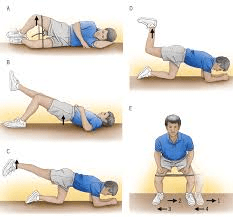
Strains – When it comes to strains of the groin and/or hip flexor, the general recommendation is to regain full range of motion, and restore full muscle strength, endurance, and coordination. You can prevent these injuries by doing programs similar to the one seen bellow (5).
Inline image 2
Summary
One of the best ways to avoid injuries of the hips is to strengthen the hips. Because we sit on our butts all day long, we tend to lose the ability to use our glutes. This can lead to all sorts of problems in the long run. This is why I recommend you start by strengthening the glute muscles. Here is a great resource for learning how to strengthen the glutes. If you’re looking for pain relief, your best chance of seeing results quickly is to consult your doctor.
References
1. The Warwick Agreement on femoroacetabular impingement syndrome (FAI syndrome): an international consensus statement
Br. J. Sports. Med. 2016;50:19 1169-1176
2. Wall, P., Dickenson, E., Robinson, D., Hughes, I., Realpe, A., Hobson, R., Griffen, D., Foster, N. (2016). Personalised Hip Therapy: development of a non-operative protocol to treat femoroacetabular impingement syndrome in the FASHIoN randomised controlled trial. Br J Sports Med, 50:1217-1223 doi:10.1136/bjsports-2016-096368
3. Verwoerd, A. J. H., Luijsterburg, P. A. J., Lin, C. W. C., Jacobs, W. C. H., Koes, B. W., & Verhagen, A. P. (2013). Systematic review of prognostic factors predicting outcome in non-surgically treated patients with sciatica. European Journal of Pain (London, England), 17(8), 1126.
4. Lewis, R. A., Williams, N. H., Sutton, A. J., Burton, K., Din, N. U., Matar, H. E., . . . Wilkinson, C. (2015). Comparative clinical effectiveness of management strategies for sciatica: Systematic review and network meta-analyses. The Spine Journal : Official Journal of the North American Spine Society, 15(6), 1461-1477. doi:10.1016/j.spinee.2013.08.049
5. Tyler, T. F., Silvers, H. J., Gerhardt, M. B., & Nicholas, S. J. (2010). Groin injuries in sports medicine. Sports Health: A Multidisciplinary Approach, 2(3), 231-236. doi:10.1177/1941738110366820

How NEAT!

So what is NEAT you ask? It is all the energy used that is secondary to planned exercise and weight training activities.

Last week I talked a little bit about incorporating NEAT (non-exercise thermogenesis) into a weight loss program. So today I will be expanding upon what exactly that means, and what it can do for you. The information for today’s post come from a study published in April of 2015.
So what is NEAT you ask? It is all the energy used that is secondary to planned exercise and weight training activities. For instance fidgeting, singing, walking, laughing, cleaning, standing, and any other movements throughout the day count towards NEAT (also see table at the bottom*). Individually these activities don’t use many calories, however, when combined the NEAT activities can generate a great deal burned calories. In fact, it is estimated that those who are lean and active burn and additional 350 calories DAILY compared to those who are sedentary. For such small changes in what you do on a daily basis those are some big results.
Here are some more highlights taken from the paper that I think you will find interesting:
– NEAT variability can explain the caloric expenditure differences in individuals with similar body types. Variances in work and leisure-time activities in individuals play a fundamental role in NEAT differences.
– By just doing simple daily manual task activities, NEAT can be enhanced throughout the workday and at home.
– NEAT decreases cardiovascular disease mortality and improves metabolic parameters.
– NEAT has good long-term adherence, with positive impact.
Check out the rest of the article at the link below, and I highly encourage you to take a look at the table at the end of this email to see what steps you can take to increase your activity. I think it is also important to remember that the ultimate goal is to create a sustainable healthy practices. There is no need to try and do all of these things at once, but to focus on creating one healthy habit at a time.
TableDaily Activities According to the Amount of Nonexercise Activity Thermogenesis (NEAT)
Activity Calories Burned per Hour
0-50 >50-100 >100-200
NEAT home activity
 Barbecuing/grilling X
 Cleaning X
 Clearing out storage space/garage X
 Cooking dinner X
 Grocery shopping X
 Hanging pictures X
 Ironing X
 Laundry X
 Organizing closets X
 Painting walls X
 Redecorating X
 Sweeping X
 Vacuuming X
General NEAT movements
 Climbing stairs X
 Pacing X
 Pushing a stroller X
 Riding in an automobile X
 Standing X
 Stretch band exercises X
 Stretching X
 Walking (strolling pace) X
 Walking and talking (briskly) X
 Walking around the home/office X
 Walking the dog X
 Walking to work X
NEAT yard activity
 Playing fetch with dog X
 Gardening X
 Mowing lawn X
 Planting flowers X
 Pruning shrubs X
 Raking leaves X
 Shoveling snow X
 Trimming hedges X
 Washing automobile X
 Watering plants X
 Weeding X
Hobbies and other recreational NEAT activity
 Baking X
 Bicycling X
 Bird watching X
 Playing board/card games X
 Bowling X
 Dancing X
 Fishing X
 Playing Frisbee or other outdoor games X
 Hiking X
 Journaling (while strolling) X
 Knitting/sewing X
 Kayaking X
 Playing the piano or another musical instrument X
 Reading (lounging) X
 Reading (standing) X
 Skiing (water or snow) X
 Surfing the Web (sitting) X
 Surfing the Web (standing) X
 Swimming X
 Practicing Tai Chi X
 Playing tennis X
 Watching TV X
 Watching TV on an elliptical trainer X
 Watching TV on a stationary bike X
 Watching TV on a treadmill X
 Playing video games (seated) X
 Playing video games (while moving) X
 Doing volunteer work (setting up/serving meals) X
 Window shopping X
 Practicing yoga X

TV = television.

*Mayo Clin Proc. n April 2015;90(4):509-519 n http://dx.doi.org/10.1016/j.mayocp.2015.02.001 www.mayoclinicproceedings.org

Hip Pain Part 1 – Your Hips Do Lie

Some basic anatomy of the hips and some common injuries that occur.

The hip is a fickle beast. When it works well and without pain, it can be used to control nearly the entire body. But, when there is discomfort within the hip, it can be caused by nearly anything in the entire body. With so much potential for disaster and success, today’s post is the first of a two-part series. In this, the first post of the series, we will be going over some basic anatomy of the hips and some common injuries that occur. Next week we will be going over how to avoid injuries and some exercises to help you recover from hip pain. So let’s get these hips shaking!
All Roads Lead To The Hips
The hips are difficult to describe. The hips control 6 motions of the legs, and there are at least 4 other motions that can be produced within the hip itself. There are at least 24 muscles and 4 ligaments that need to be considered when talking about hip motion. Not to mention the complex array of nerves, cartilage, and other tissues that need to be taken into account. Instead of boring you with the specifics, I’ll just say that there are no black and white answers when it comes to your hip pain. But we do have a lot of opportunities to find clues to the answer for your problems.
Inline image 1
Endless Possibilities
Hip problems are so complex that they may not even have symptoms that appear anywhere close to the hip! So let’s dive head first into some of the most common issues.
Femoroacetabular impingement (FAI) – FAI is the new kid on the block because we have only recently recognized it as a true issue. FAI can cause symptoms such as pain that you feel deep in the groin which may be mistaken as a groin strain (1). Overgrowth of the bones of the ball and socket joint of the hip cause tearing of cartilage in the joint (2). This problem can lead to early arthritis and affects about 10-15% of young adults (3). There is not a deep understanding of how this occurs yet, but we are learning more about it every day.
Inline image 2
Labral Tear – The labrum is a cartilage bumper within the socket of the hip. This problem can cause pain, catching, or clicking in the groin with activities. Labral tears can be caused by issues such as FAI, but they require an MRI to be diagnosed (4).
Athletic Pubalgia – AKA sports hernia. This issue can cause pain in the lower abdominal or groin area of athletes. The injury affects the lower abdominal wall, or adductor tendons, and is generally related to sport-specific movements (e.g. slap shot). This injury may require an MRI to diagnose (5).
Hip Flexor Strain – The hip flexors are the muscles along the anterior (front) aspect of the hip. Pain in the front of the hip when lifting the leg up will be experienced with this injury. 
Adductor Strain – Also known as a groin strain, this issue is tough to differentiate from other injuries of the hip (2). Usually, an adductor strain involves a stretch or possibly a small partial tear of the muscle or tendon. These injuries can have a gradual onset with diminished performance, and warms up, or, an acute onset that worsens during exercise (5).
Osteitis Pubis – This is an overuse condition causing inflammation of the junction between the pubic bones.You might feel pain deep in the groin when playing sports involving a rapid change of direction or bringing the lower extremity across the body. You might also experience pain radiating to the thigh or bone tenderness (5).
Piriformis Syndrome – This issue is described as a neuromuscular disorder that is presumed to occur when the sciatic nerve is compressed or involved at the level of the piriformis muscle (6). You may experience sciatica-type symptoms, pain when sitting, and/or pain with hip flexion, adduction, and internal rotation.
Inline image 3
Trochanteric Bursitis/Snapping Hip – Pain at the top of the hip is common especially among runners. Sometimes associated with IT band syndrome, these issues can often be caused by friction, overuse, trauma or too much pressure. You may experience symptoms such as pain getting up off your bed or pain while lying on the floor and sharp burning pain over the lateral thigh that worsens with exercise for bursitis and snapping hip respectively (7).
Sciatica – Sciatica is the result of a neurological problem in the back or an entrapped nerve in the pelvis or buttock. You might experience a pain in the butt (not spouse related), numbness, weakness, leg pain, or a host of other symptoms (8)
 
Summary
The problems listed above are just the tip of the iceberg. There are loads of other injuries that I would love to get into, but I will save my nerdiness for another day. What you need to know is that your groin pain may not be a simple groin strain. The sciatica you have been complaining about all these years may not actually be sciatica at all. And no matter what the issue is, there is going to be a solution to your problem. So be sure to read my next post to find out how to resolve your rear end issues!
Don’t forget to like me on Facebook!
References
1. Sansone, M., Ahldén, M., Jonasson, P., Thomeé, R., Falk, A., Swärd, L., . . . Institute of Neuroscience and Physiology, Department of Clinical Neuroscience and Rehabilitation. (2014). Can hip impingement be mistaken for tendon pain in the groin? A long-term follow-up of tenotomy for groin pain in athletes. Knee Surgery, Sports Traumatology, Arthroscopy, 22(4), 786-792. doi:10.1007/s00167-013-2738-y
2. Chakraverty, J. K., Sullivan, C., Gan, C., Narayanaswamy, S., & Kamath, S. (2013). Cam and pincer femoroacetabular impingement: CT findings of features resembling femoroacetabular impingement in a young population without symptoms. AJR. American Journal of Roentgenology, 200(2), 389.
3. Leunig M, Ganz R. Femoroacetabular impingement: a common cause of hip complaints leading to arthrosis [in German]. Unfallchirurg 2005; 108:9–10, 12–17
4. Falvey, E. C., Franklyn-Miller, A., & McCrory, P. R. (2009). The greater trochanter triangle; a pathoanatomic approach to the diagnosis of chronic, proximal,lateral, lower limb [corrected] pain in athletes. British Journal of Sports Medicine, 43(2), 146.
5. Falvey, E. C., Franklyn-Miller, A., & McCrory, P. R. (2009). The groin triangle: A patho-anatomical approach to the diagnosis of chronic groin pain in athletes. British Journal of Sports Medicine, 43(3), 213-220. doi:10.1136/bjsm.2007.042259
6. Miller, T. A., White, K. P., & Ross, D. C. (2012). The diagnosis and management of piriformis syndrome: Myths and facts. The Canadian Journal of Neurological Sciences. Le Journal Canadien Des Sciences Neurologiques, 39(5), 577.
7. Franklyn-Miller, A., Falvey, E., & McCrory, P. (2009;2008;). The gluteal triangle: A clinical patho-anatomical approach to the diagnosis of gluteal pain in athletes. British Journal of Sports Medicine, 43(6), 460. doi:10.1136/bjsm.2007.042317
8. Koes, B. W., M. W. van Tulder, & Peul, W. C. (2007). Diagnosis and treatment of sciatica. BMJ: British Medical Journal, 334(7607), 1313-1317. doi:10.1136/bmj.39223.428495.BE

Play Like a Champion

STOP MAKING EXCUSES!!

Today I wanted to talk motivation. As we move into the cool fall weather I am hearing more and more excuses for everything that requires motivation. So the theme today is STOP MAKING EXCUSES!!
Harsh words, I know. But we all find excuses when we don’t see success, or lose sight of what’s important. The article today does a good job making a point of what needs to be done to get things done. I highly recommend you read the article in it’s entirety, but here are the three main points.
1. Stop the Excuses. No, Seriously. Stop.
2. If you blame yourself – success.
3. If you blame everything else – no success. Period.
I cannot say enough about personal responsibility. A common example for not seeing success due to a lack of responsibility is environment. We’ve all been there. “Oh I ate bad last week because”… my friends dragged me out to the bar every night … my significant other didn’t want to cook so we ordered out … all I had was frozen dinners in the freezer etc. etc. etc.
My point is that we all need to stop blaming others and take a hard look why we eat bad or don’t exercise as much as we should. Weather it’s learning to say “no” to your friends once in a while, taking over cooking duties for a while instead of ordering out, or making time in your week to ensure you have actual food around the house, or even admitting that you don’t know what to do or where to start. We spend our entire lives getting to where we are right now, so to see changes we need to take responsibility and make changes, or seek out someone who can help.